[ Home ]
[ aca / en / f / h3 / i / jp / t / v ] [ dis ] [ Home ] [ FAQ ] [ Rules ] [ Catalog ] [ Archive ] [ RSS ]
Board Statistics
Board PPD Total Posts Unique Posters Last Post
Take it easy!

61a9c7ee8a531fc83b18961df9ec6f06b141fccb.png - 271.12 KB (700x700)

Is it just me or this the best design of Rin ever made ever?

>>

>>12286 Black clip. It stands out more in that outfit.

>>
rin-white-shaded.png - 243.87 KB (700x700)

>>12287 What about with shading?

>>

>>12288 Hmmmm. That is nicer than before, I will say. It's hard to say, I think I still prefer the black clips though.

>>

adult rin very cute, but... does len have his own adult version too?

>>
s-l1200.jpg - 223.90 KB (1200x1200)

i'm aweare that there are muttiple fan desings of len as an adult, so does rin, but the rin that you posted is a very popular fan desing that even it has its own figurine. so, what about len?


https://www.youtube.com/watch?v=qWXnt2Z2D1E

I want to talk about horror media that is sourced from the internet. Not necessarily full-release movies or well-known published games. I'm thinking more analog horror, creepy videos, horror flash/indie games, even stuff like the SCP foundation falls under this category. Bonus points for more niche stuff or media you consider internet history. Starting this thread off with this video. I love this one, I am a huge huge fan of atmospheric horror and I think this is a great example of such.

>>
image.png - 220.37 KB (755x755)

Another awesome find that I did not know about until recently was a flash game from 2009 called Lomando, luckily it was ported so we can still enjoy it today. It's a strange puzzle game about searching through a haunted house. https://www.lomando.com/main.html

>>
https://www.youtube.com/watch?v=7esdLo2f7mo

This one is decently new, came out last year. It's not the spookiest thing I have ever seen but I enjoy it. More than jumpscares or gore, I REALLY love horror that makes me feel deeply unsettled. Uncanny valley and such.


Screen Shot 2026-03-30 at 4.51.32 AM.png - 92.20 KB (1132x839)

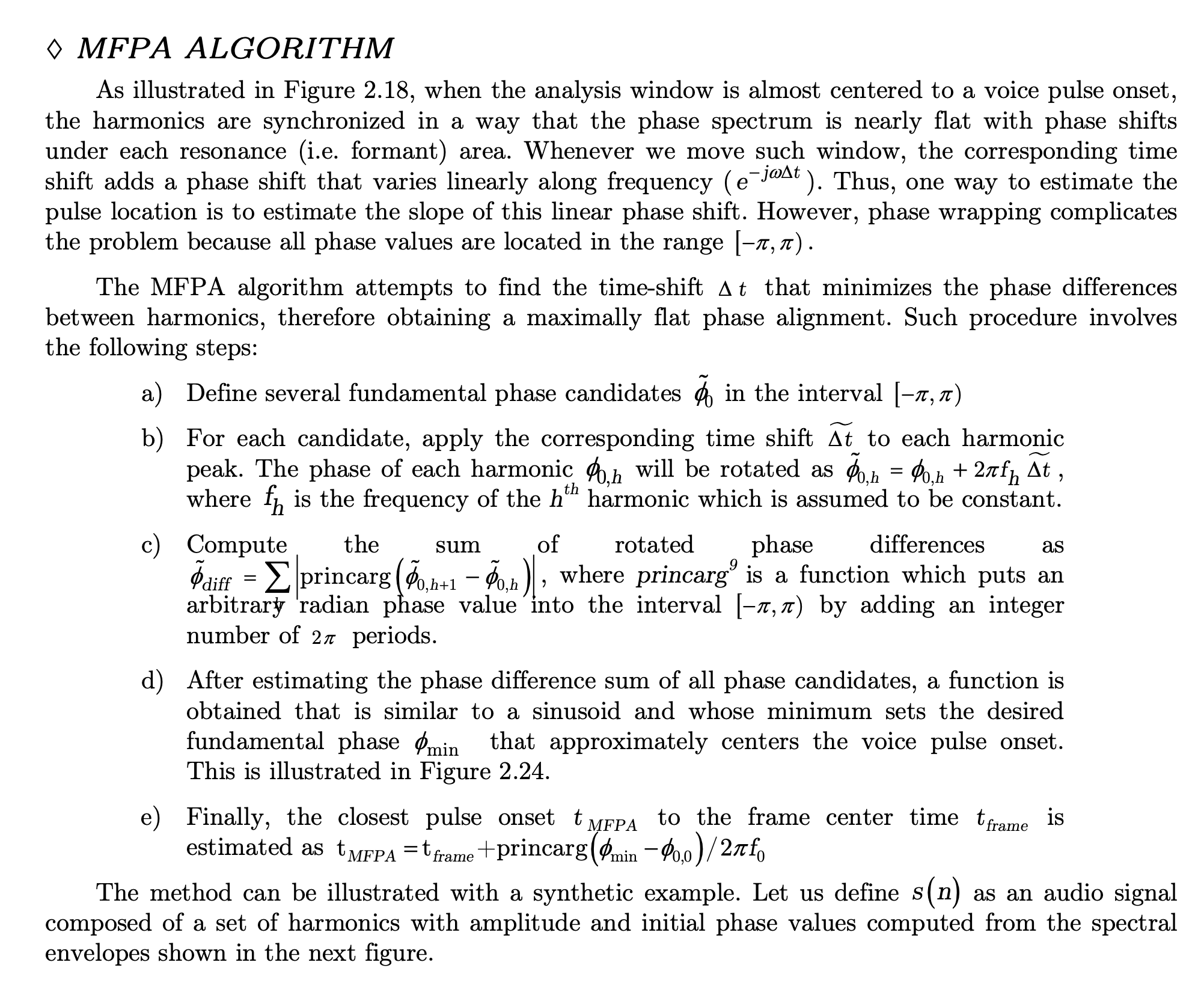
Hello, I'm back and I have a major update to my VOCALOID project! I have sucessfully achieved a shape-invariant pitch transposition! Here it is. First the original audio: https://files.catbox.moe/zmt3rr.wav Now my version with WBVPM (pitched down by an octave): https://voca.ro/1mJ5qljrp9hD or https://files.catbox.moe/kho97n.wav And a version using a naive pitch shift: https://files.catbox.moe/xs39bq.wav Notice that my version, while having more noise, sounds more natural and has less phasiness. This is particular noticeable if you play both at very low volume. One sounds much more 'human' than the other. Also note that this an extreme example with an octave shift (or 1200 cents) - in practice, shifts would typically be far less. Also this doesn't implement several other parts of the system (more on that later). I'll explain all of this in a moment, but first, I'd to correct some major biographical errors. Since this is a long post, I've divided it into sections BIOGRAPHICAL CORRECTIONS In the last post, I claimed that VOCALOID1 used Narrow-Band Voice Pulse Modeling while VOCALOID2 and onwards used Wide-Band Voice Pulse Modeling. This was incorrect, and additionally it was the source of most of my confusion surround the paper. What actually happened is that the research technology that would later become VOCALOID1 started out as work to improve the existing Spectral Modeling Synthesis system that had been developed in the early 1990s. This improvement began work in the late 1990s. But importantly, this system evolved and techniques from it were incorporated with techniques from a system that was being developed called a Phase-Locked Vocoder, and this system would be released as VOCALOID1. In the mid-2000s, work began on combining the techniques learned from improving SMS and the PLVC-based system and attempting to combine them with the mucher older and well-known TD-PSOLA system. Importantly, TD-PSOLA (Time-Domain Pitch Synchronous OverLap and Add) was a time-domain system, while SMS was a frequency-domain system (and also TD-PSOLA was pitch synchronous - hence the name, while SMS had a constant hop size). The first technique they developed was Narrow-Band Voice Pulse Modeling, and later Wide-Band Voice Pulse Modeling. Wide-Band Voice Pulse Modeling ended it up being used in VOCALOID2. Now that I understand this, I also understand the major mistake I made when reading the paper: I was reading it from the perspective of an implementer, thinking of the sections as the steps to implementing it instead of as research. I had thought that section 2.2 described the core processing algorithms. When it was actually about SMS, and importantly, about *the improvements they made to SMS*, and not a complete description of SMS, since SMS was already an established technique. Hence my confusion on why some things were seemingly vaguely explained, since *the paper wasn't about them*. At the same time, much of that section is very useful though because importantly, much of that research was also incorporated into the later techniques. RESULTS I have successfully implemented the Wide-Band Voice Pulse Modeling; synthesis; and pitch transposition, time stretching, and timbre scaling algorithms. Additionally, I have also finished implementing the full version of the pitch estimation module, changed the code to work using overlapping windows, implemented the window adaption system, and fixed countless.

>>

ADDENDUM, because I just realized I forgot a bunch of things I meant to put into this post This is still a simplified model. It does not take into the Excitation plus Resonance model, the Spectral Voice Model. It uses a linear transform and not generated trajectories. One thing I was thinking about was the part in WBVPM section where they said that one of the disadvantages of WBVPM was not being able to separate harmonic and non-harmonic. I also read that the noise is embedded as fluctuations in the spectrum of each voice pulse and over time, which is what I had presumed because the information has to go somewhere. I was thinking, what if you took each harmonic as the values and the pulse onsets times as the positions in a spline. Then interpolated at regular intervals. Then applied the fourier transform. Then separate the highest frequencies and the others. Take the others and apply the inverse Fourier transform, and then rebuild a spline from this and interpolate the values back at the onsets. I wonder if this would work. There would be loss though because of the resampling steps. This could decreased by taking more samples. You could also apply a correction by sampling and sampling it back to calculate the resampling loss itself without the removal of the high frequency modulations, and then add this difference back to the main pulse information after the separation.

>>

Hello I'm back with another update to my VOCALOID project. It's not as big an improvement as last time - and in fact, there's no new features - but I felt like it was worth posting. I've been trying to rectify the major issues before I move onto implementing the Excitation plus Resonance model. The first thing I attempted to tackle was all the added noise at high frequencies. Here's the original spectrum: https://files.catbox.moe/fq55bo.png And here's the reconstructed spectrum (with no transforms applied): https://files.catbox.moe/gq7jff.png You can clearly see the high frequency artifacts. The first thing I tried was something mentioned in the paper. In the paper, specifically the WBVPM section, it was mentioned that there are two approaches for a non-integer size discrete fourier transform. The first one is repeating the signal while second is upsampling it. I went with second as the former is patented and also because the second is easier to implement. It is mentioned that increasing the repetition count of the signal (or in the case of upsampling, the upsampling factor), and then discarding the higher frequencies, can improve the estimation by reducing artifacts. In the case of repetition, it is also mentioned that quadratic interpolation can be used in the resulting spectrum, however I am not sure if this can be done for upsampling and as such, I have not tried to implement it for now. Here's the result after applying an upsampling factor of 3: https://files.catbox.moe/qcgnzq.png Here's the original audio: https://files.catbox.moe/f7g8ta.wav The original reconstruction: https://files.catbox.moe/da0m1i.wav And now with the improved reconstruction: https://files.catbox.moe/513ycn.wav You can see an improvement, especially at lower frequency, however the high frequency artifacts largely persist. So they have to be arising elsewhere. I realized the source was the reconstruction of the signal (AKA the "synthesis"). I had previously implemented a synthesis method that was quite different from the one used in the study, because I did not understand the method in the study at first. My synthesis method worked by taking each voice pulse and for each sample where the voice pulse is the closest voice pulse to that sample, setting the value of that sample to the interpolated value of a spline representing a time domain version of the upsampled voice pulse with a step corrospondin between the ratio a sample in the regular time domain and the upsampled time domain. Now, in some cases, estimation inaccuracies and differences from any transformations that were applied result in these regions of samples being bigger than the actual sample itself. In these cases, we take advantage of the period nature of the voice pulse and repeat it (i.e. sampling before the start is equivalent from that offset from the end, and sampling after the end is the same as that offset from the start). However, this method results in discontinuities in some cases. Here is an example of such a discontinuity: https://files.catbox.moe/jnnxfj.png I began to try to implement an interpolation system. In this system, we could calculate the gap between pulses - or in the cases of inaccuracies in the other direction (i.e. overlapping pulses) - the overlapping area, and interpolate between one pulse and the other linearly. However, this was approach was complicated significantly by the non-integer (and potentially differing) sizes of the pulses as well as numerous edge cases. For this reason, I struggled to do so and spent over an hour trying to figure out how to do it corrrectly. About half way through, I decided to check the paper again and this time I understood the actual synthesis method properly, largely because of a diagram I had missed the first time.

>>

>>12281 In the actual method, each pulse is is expanded in a manner similar to that of the border interpolation technique used in WBVPM analysis, except kind of in reverse. In this technique, for each voice pulse, we generate extensions on both sides with each extension having the size of the border interpolation ratio of the size of the voice pulse. Then we apply a trapezoidal window to the voice pulse which starts at zero at each side of the extended voice pulse and becomes 1 on either side after protrusion of twice the border interpolation size on each side. Then we overlap and add the voice pulses. This technique fixes the discontinuity issue because it effectively results in each border-interpolation-length side of each voice pulse being interpolated with the corrosponding section for the other voice pulse linearly over a period of twice the border interpolation size. However, this only holds perfectly when the fundamental frequency is the same for both voice pulses (and thus they are the same size) and they are spaced out at onsets that are exactly the period of the fundamental frequency apart. However, when this in not the case, some amount of modulation occurs that results in some voice pulses being attenuated while others are accentuated. This is especially noticeable when there are large inaccuracies in the fundamental frequency estimation and/or the voice pulse onset sequence. Here's the same section from before. Notice how now it does not have a discontinuity: https://files.catbox.moe/p26914.png Now here's a zoomed-out version: https://files.catbox.moe/zacw8w.png Now here's a section with large inaccuracies in the MFPA estimation that clearly shows large modulation artifacting: https://files.catbox.moe/efk1vx.png Here's the new spectrum: https://files.catbox.moe/f94zse.png You can see that while the high frequency artifacts are now gone, there are now more low frequency artifacts. In fact, the overall amount of artifacts is actually higher than before. Here's the reconstructed audio: https://files.catbox.moe/ympfi0.wav While I ended out solving this issue by fixing large inaccuracies in the MFPA system, it is interesting to note that my approach is more resilient to estimation inaccuracies. Perhaps for a future improved vocal synthesizer, it would be worth exploring a variant of my periodic continuation technique adapted with an interpolation method that could handle changes in pulse onset and f0. The first thing I tried was switching to a magnitude-limited logarithmic scale for the ampltiude in the MFPA function instead of it being linear. However, this resulted in little to no effect. The next thing I tried was adjusting the size in periods of the window used for the peaks that are fed into MFPA, however again this resulted in little to no effect. Next, I tried implementing the harmonic peak selection algorithm I proposed in the previous post, but again this resulted in little to no effect. Finally, I began looking at the MFPA refinement algorithm instead, and I found something quite interesting: In this section, these are the per-frame detected onsets: https://files.catbox.moe/f36gno.png Now here's the onsets chosen by the MFPA refinement algorithm: https://files.catbox.moe/4b7hc0.png

>>

>>12282 Notice that while one of the onsets in the detected onsets is wrong, there is also a correct one for that voice pulse, and additionally, the incorrect onset chosen was actually for the next pulse. Furthermore, that incorrect chosen onset was actually not even a detected one - the one detected for that frame was correct - so it must have been one of the additional onset candidates considered by the MFPA refinement algorithm. I realized shortly after what the issue was: When I first wrote the MFPA refinement algorithm, I was under the false assumption that it's primary purpose was to compute a superset, rather than a subset, of the detected onsets. Because of this, I realized I could make a simplification to the algorithm. In the paper, it says to calculate the MFPA error by finding the closest MFPA onset to the frame. However, since I thought there should be at most onset per pulse in the detected onsets, we could do this by just getting the onset time at that frame index (where we get the frame index by rounding the time). I believe actually even written the code originally to use a search, but simplified it. But since now there can be (and usually are) multiple detections per pulse, that assumption is no longer true and by doing that, we may choose a pulse which is not actually the closest. In the case I show above, what probably happened was that the wrong detection in the previous pulse was chosen, resulting in choosing the wrong one for the next pulse. I fixed the issue by making it use a search (and also sorting the detected onsets first), and it fixed that section: https://files.catbox.moe/0oryig.png Here's the section that was heavily modulated before: https://files.catbox.moe/r0oq2w.png And here's the spectrum: https://files.catbox.moe/pgfqfh.png Notice the low frequency artifacts are mostly gone. And here's the reconsutrcted audio: https://files.catbox.moe/98zbd1.wav Now here's the pitch transposed audio with the fixes applied: https://voca.ro/1izsfK1Ewhaha3 Compare to before: https://voca.ro/1mJ5qljrp9hD

>>

Much of this goes very over my head but it's cool to see the work you're doing hikarin. Thenk you for sharing your hard work.


teeeeeeeeeeeeeeeeee.jpg - 51.08 KB (474x474)

It's Kasane Teto's birthday!!!!!!!!

>>

who cares. worst vocaloid and adopted by newfags. Luka will always be on top

>>

>>12276 Nuh uh angry

>>

>>12277 Yeah huh ( ´ω`)


Boku_No_Pico_(Peeing_scene).gif - 239.28 KB (430x242)

キタ━━━(゚∀゚)━━━!!

>>

>>12228 Whoag it's raining!!love

>>
hmm.gif - 1995.68 KB (498x498)

In my theory, they are watering the plants!neco

>>

I want to be watered lovedrool

>>

>>12255 C'mere hikarin, I have some gardening to do. snicker


converted_osaka.png - 7.46 KB (164x164)

Since we managed to put Hikari-chan in Japan let's go ahead and leave a mark in unusual places around the world. In the last thread someone suggested putting the Osaka in another location, since the other was was being removed and there weren't enough people restoring it. I found a decently populated zone in Chile with a large blank space that we can claim snicker Blue Marble (for loading .pngs): https://github.com/SwingTheVine/Wplace-BlueMarble Blue Marble Coords: 623 1202 228 944 Map Themes (Use dark theme so you can see where white pixels are): https://greasyfork.org/en/scripts/546642-wplace-map-themes Direct Link to Location: https://wplace.live/?lat=-29.996731850630262&lng=-70.42667025322265&zoom=12.894664790191456

Your fortune: Average Luck

>>

>>11313 The problem was with bots spamming deltarune and pride flags literally everywhere. Its mostly subsided for now. Now I see korean idols everywhere.

>>

>>11334 idk, I just went to five random places on the map and all of them had at least one flag, three of them having trans flags.

>>
image.png - 41.51 KB (900x600)

Can you do One in my Country (Aka Egypt)

>>
792328b1fc89ba551ae83f840a8163d7.jpg - 50.10 KB (736x736)

>>43 Another Egyptian spotted!

>>

>>12257 Egyptbro, give me a location and an image and i'll help


Dunhuang_Yiqiejing_yinyi.svg.png - 2971.66 KB (1920x1120)

Discuss cool chinese stuff here I'll start: >The Yongle Encyclopedia is a Chinese leishu encyclopedia commissioned by the Yongle Emperor (r. 1402–1424) of the Ming dynasty in 1403 and completed by 1408. It comprised 22,937 manuscript rolls in 11,095 volumes. Fewer than 400 volumes survive today, comprising about 800 rolls, or 3.5% of the original work. >Most of the text was lost during the latter half of the 19th century, in the midst of events including the Second Opium War and the Boxer Rebellion. Its sheer scope and size made it the world's largest general encyclopedia, until it was surpassed by Wikipedia in late 2007, nearly six centuries later imagine how cool it would've been if it survived cry >i wanna learn https://archive.org/details/chineseenglishbilingualvisualdictionary_201909

>>
>>
Chaozhou_Opera-Menglikung.jpg - 64.30 KB

>>11672 Hikarin, have you been playing Civilization VII? Do you know if there are any good mods for Civilization VI? I wonder if it's received updates happy I learned about the Chaoshan region of China, it had been the origin of a lot of derivatives of it's culture, as it had been home to a lot of migration overseas. It had a lot of impact on Singaporeans, along with Indonesian Chinese, who were often the majority landowners, strangely often. Quite a few people there speak a variety of Mandarin that is the closest to ancient Chinese, and they're often referred to as the Teochew people. They also have a coming of age ceremony. Interesting people. https://www.omniglot.com/chinese/ A useful page for people trying to learning languages, a lot of documentation I'd recommend the movies, „An Elephant Standing Still” and „To Live” on https://kisskh.ws/ which I found a lot of East Asian shows in Also try out https://lightnovelpub.org/ for quite a few webnovels, albeit in English, Qidian would be better for Chinese https://www.konglongmandarin.com/ Another interesting website I came across to learn Mandarin from Peppa Pig

>>
雁塔_乐游原·青龙寺_11.jpg - 7989.06 KB (5152x3864)

「 衆鳥高飛盡 孤雲獨去閒 相看兩不厭 只有敬亭山 」 「 The birds have vanished down the sky. Now the last cloud drains away. We sit together, the mountain and me, until only the mountain remains. 」 A poem about the Jing-Ting mountain, related to Zazen in Buddhism, which is related to the meditation. It's interesting how Japan diverged from Chinese Buddhism with schools of esoteric Buddhism with skull rituals. https://en.wikipedia.org/wiki/Tachikawa-ryu Chinese esoteric Buddhism never really flourished because of the persecution that arrived shortly after it began to be taught, and the name for it is literally related to the Tang dynasty - 唐密 It seems to be undergoing a small revival, with the designation of these temples by esoteric monks as important sites, because of their cultural influence outside China

>>
Laozi_002.jpg - 62.44 KB (600x450)

Been a while since I visited this site hello Hikarins happy! 搭子文化 is an interesting sociocultural phenomenon within China today where people make friends based on their social status in life https://en.wikipedia.org/wiki/Dazi_culture https://www.wenlinshe.com/tw/ this is a very cool library with a lot of classics and idioms that could be useful http://www.robos.org/sections/chinese/cangjie.html this provides information on cangjie which is a useful system to type Chinese and makes use of the radicals, with keys mapped to them 「 夫禍富之 轉而相生 其變難見也 」 「 Disasters and abundance take places with one another It is difficult to make certain 」 These are two lines from the 淮南子 about the old man near the border who had lost his horse. It is a pretty famous parable, and parables, addages, or idioms in Chinese are often referred to as 成語 https://sites.google.com/site/wenzhoudialect/anthology/baidu-wenzhou-dialect this regards "Wenzhounese" a division of Wu Chinese, which is also close to Shanghainese. Wenzhounese is famous for it's uniqueness, with around eleven tones, with phrases describing it discussing it's remoteness "天不怕,地不怕,就怕温州人说温州话" "Fear not the heavens, nor the earth, but the Wenzhou man speaking Wenzhounese. It is regarded as one of the devil dialects. https://github.com/ZWolken/Great-Dictionary-of-Modern-Chinese-Dialects/blob/main/%E5%B9%BF%E5%B7%9E%E6%96%B9%E8%A8%80%E8%AF%8D%E5%85%B8.pdf this is a document regarding a 2002 compilation of the fourty two modern Chinese dialects 躺平 is a term used to mean "lie flat" and it is mostly a word used by a lot of NEETs in China, kukuku is an example of an old Chinese imageboard, although their culture is very isolated https://english.shanghai.gov.cn/en-LearnChinese/index.html a useful site from the Shanghai government I also learned about tone sandhi, where the tones change regarding the context and the previous tone that precedes a phrase, it is pretty strange and hard to figure out https://opentext.ku.edu/tingyiting/chapter/lesson22/ 邯郸学步 is a unique phrase that I relate to, it warns one to not copy another person blindly, and regards the Handan walk, which was sort of an old trend in ancient China https://www.straightdope.com/21343499/is-the-chinese-word-for-crisis-a-combination-of-danger-and-opportunity there is a lot of discussion on whether the Chinese word for disaster is a combination of danger and opportunity There is also an obscure practice where Chinese characters are used and picked as a form of Astrology, there are few pages on it https://www.stronghold-nation.com/history/myth/literomancy There is a lot of use of seals or chops within businesses in China, and it's often discussed in the legal context, it is sort of like a more official signature compared to ordinary 签字/ https://harris-sliwoski.com/chinalawblog/is-that-a-real-chinese-company-chop-stamp-seal/

>>

>>12247 very kool resources chikarin, thank yew


image.png - 1584.87 KB (987x1262)

So glad I setup a private szurubooru instance. Now I can finally organize all my images and access them from anywhere happy Feel free to use this thread to share cool images

>>
banana.png - 318.51 KB (853x637)

>>12240 here is a cool image

>>
image.png - 1782.72 KB (1867x1080)
>>

>>12245 when sharing links, you should delete everything after the ?is= it's all tracking info

>>

>>12246 OH FOR FUCK SAKE!

>>
1000021660.jpg - 45.19 KB (474x693)

here's a cool image shades


1000022060.jpg - 429.24 KB (636x900)

HIKARIN! You dumb, smelly, roody-poo candy ass NEET! Take a freaking sbower already! I can smell you from 3 threads over! angryeww

>>

Shut the fuck up mokou, you know damn well you've been wearing those same clothes for at least 500 years

>>

>>12237 mokou musk... drool drool drool


Delete post: [ File only ]